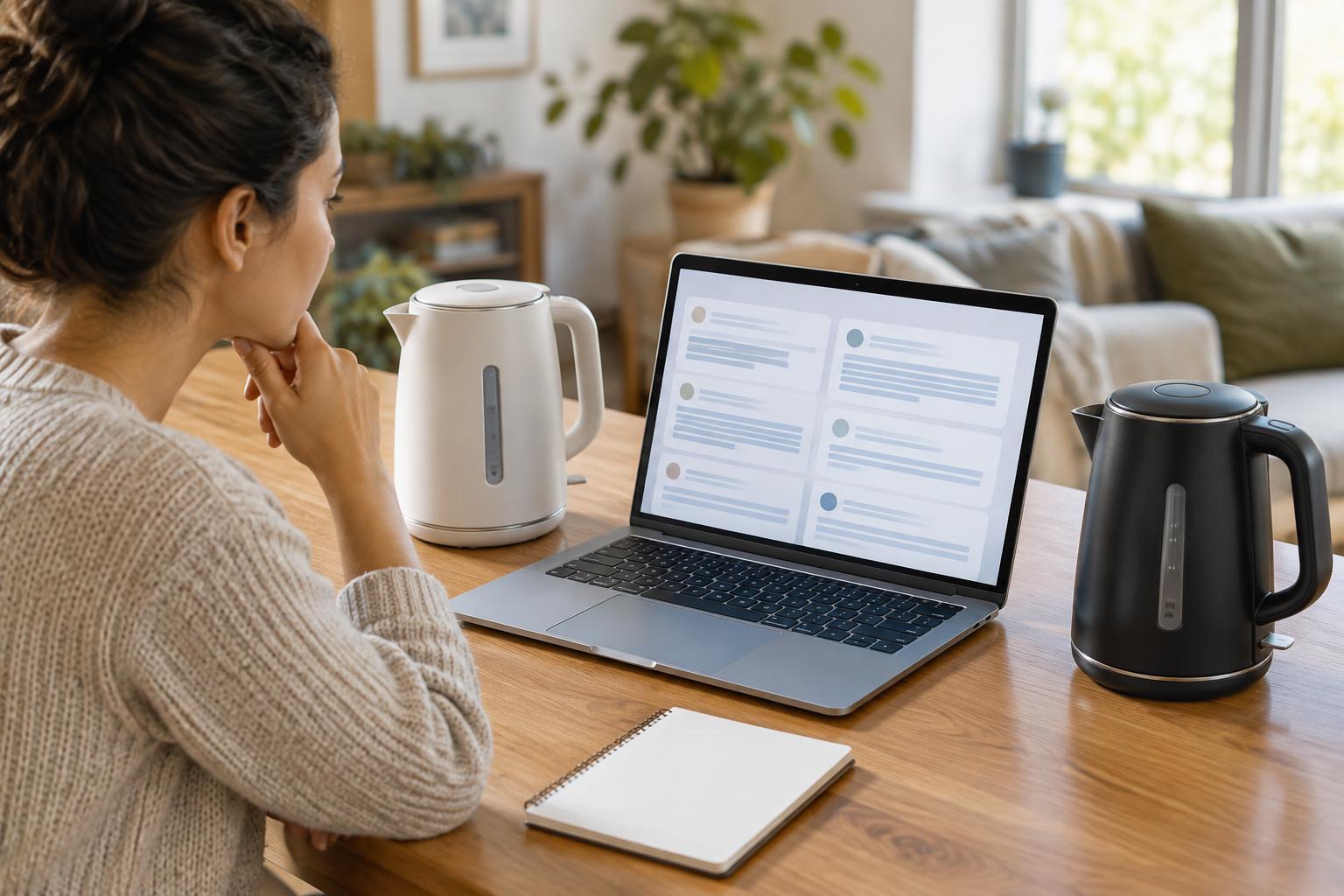
Start with the question behind the stars
A star rating compresses many experiences into one number. That makes it convenient for narrowing a long list, but it can hide why people were satisfied or disappointed. Two products with similar averages may have very different strengths: one might be easy to use but wear out quickly, while another might be durable but difficult to set up. Before reading reviews, write down what matters most to you. Is it fit, ease of cleaning, customer support, noise or something else? A review becomes more useful when it helps answer a question you already have.
Keep the purchase in perspective, too. For a low-cost item, a quick scan for common problems may be enough. For something you expect to use often or keep for years, spend more time comparing specific experiences. The goal is not to find a product with no complaints. It is to understand which trade-offs you can accept.
Look for patterns, not a single persuasive story
Begin by reading a mix of favorable, middling and unfavorable reviews. The highest and lowest ratings can reveal strong reactions, while middle ratings often describe compromises. Notice whether the same issue appears across different reviews. Repeated comments about a confusing control, an awkward size or a helpful instruction guide are generally more informative than one vivid account on its own.
Pay attention to the conditions behind each experience. A complaint about battery life means more if reviewers explain how they used the device. Praise for a jacket’s warmth is easier to interpret when a reviewer describes the weather and what they wore underneath. Specific details do not guarantee accuracy, but they give you something to compare with your intended use.
Patterns also need context. Several complaints may concern an older version, a particular size or a delivery problem rather than the item itself. If a review page covers multiple variants, check which one each reviewer bought. Separate observations about the product from opinions about shipping, packaging or expectations set by the listing.
Consider whose experience applies to you
Reviews are written by people with different needs and standards. Someone who values a compact design may happily accept a smaller capacity; another person may see that same feature as a flaw. When a reviewer states what they were trying to do, compare their priorities with yours before treating their verdict as guidance.
This is especially important for claims such as “comfortable,” “simple” or “good value.” Those words depend on the person using them. Look for descriptions that make the judgment concrete: how long the item was worn, which step was hard to complete or what the reviewer compared it with. A review that reaches the opposite conclusion from yours can still be helpful if it clearly explains the trade-off.
Remember that the people who post reviews are not necessarily a representative sample of all buyers. Some may write because they had an unusually good or bad experience; many others may never leave a review. Treat the review page as a collection of clues, not a vote that can predict your own experience with certainty.
Check credibility without playing detective
A detailed review is not automatically trustworthy, and a short one is not automatically false. Instead of trying to label individual reviewers, look for reasons to be cautious. Many near-identical comments, vague praise that could describe any product, or a sudden cluster of reviews with little practical detail may give you less useful information. These signs are not proof of manipulation; they are reasons to seek more context.
Labels such as “verified purchase” may tell you something about how a platform recorded a transaction, but they do not establish that every opinion is fair or relevant. Photos can clarify size, finish or assembly, yet a photo may not show how an item performs over time. Use platform features as supporting evidence rather than as substitutes for reading what a reviewer actually experienced.
If possible, compare reviews across more than one seller or review space. Differences may reflect the customers, product versions or questions each space attracts. Focus on whether the same practical strengths and limitations appear, rather than trying to reconcile every rating.
Turn what you read into a decision
After reading, make a short list of what seems reasonably well supported, what remains uncertain and what would be a deal-breaker. For example, you might conclude that assembly is usually straightforward, sizing varies by intended use and durability is unclear because few reviewers mention extended use. That summary is more actionable than remembering only an average score.
Then check whether the product description answers your unresolved questions. Dimensions, materials, compatibility information and care instructions can help you test claims found in reviews. If an important question remains unanswered, consider a different option rather than filling the gap with the most confident review.
Online reviews work best as a way to anticipate everyday experiences, not as a final verdict. Let the stars help you find candidates; let the details help you decide whether those candidates suit your needs.